
Waseda University · Humanoid · 1984
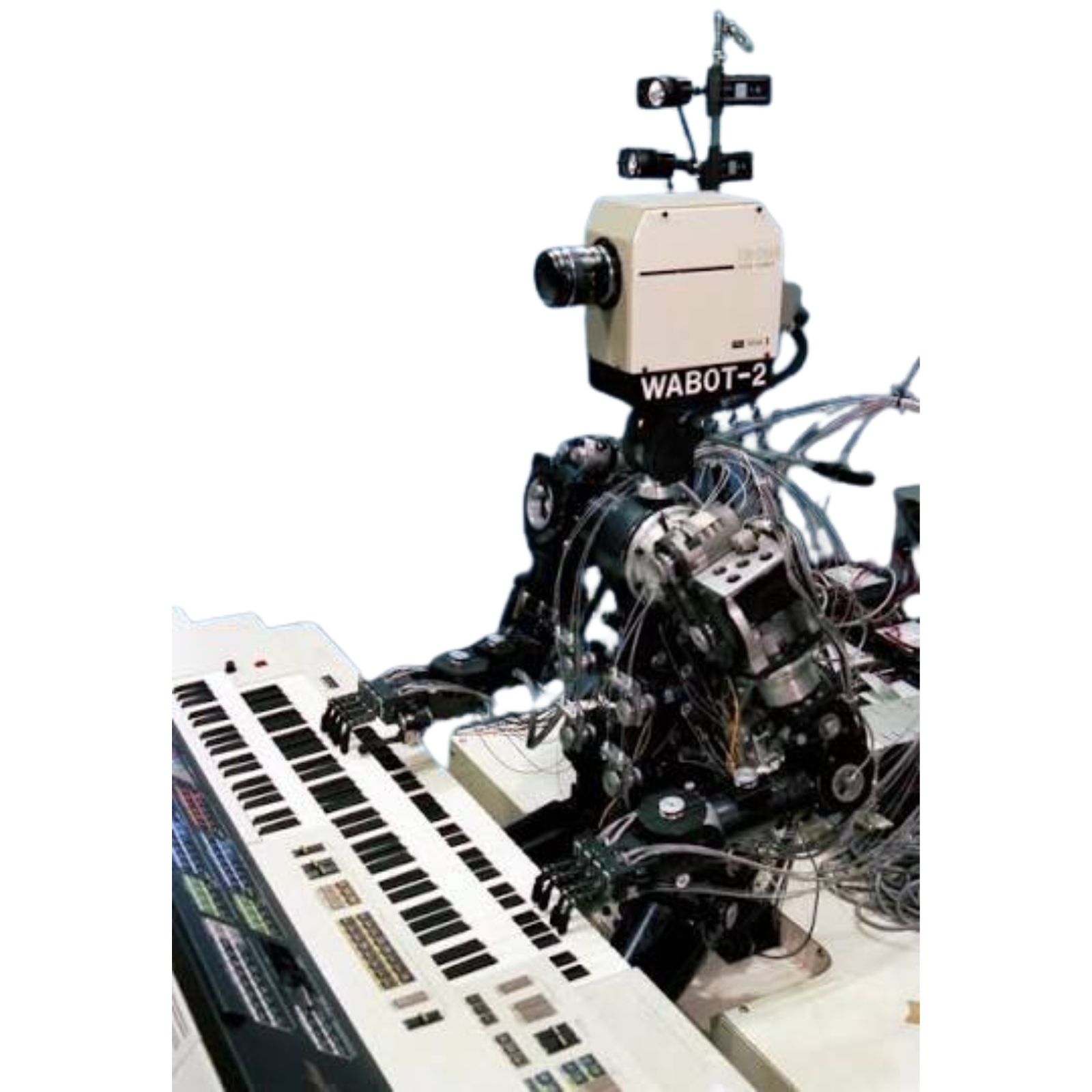
WABOT-2, introduced in 1984 by Waseda University's Kato laboratory, was the world's first musician humanoid robot — a 50-degrees-of-freedom machine that could read a printed musical score with its CCD-camera head and play a Yamaha FX-1 electronic keyboard using both hands and feet, even adjusting its performance to accompany a human singer. Its five-fingered hands with 3-DOF fingers performed precise, delicate keypresses, driven by DC motors and harmonic drives. Its distributed computing was remarkable for 1984: a 16-bit Zilog Z8001 for high-level limb control, two Z8002s for mid-level control while playing, and fifty 8-bit Z8094 CPUs — one dedicated to each degree of freedom — for low-level motor control. WABOT-2 demonstrated that humanoids could perform artistic, dexterous, real-time tasks, not just walk. NOTE: historic entry from Waseda archives and the robotics record — verified specs; overall mass/height not consistently published (flagged).
Price on application
View full interactive profile, comparisons & videos →| Category | Humanoid |
| Sub-type | Musician Humanoid (historical) |
| Status | Active |
| Year | 1984 |
| Origin | Japan |
| Announced | 1984 |
| Released | 1984 |
| Weight | 120 kg |
| Degrees of freedom | 50 |
| Camera | CCD camera (head) — reads musical scores |
| AI model | Reads a musical score via CCD camera, plays an electronic organ (Electone), converses, and adjusts its performance to accompany a human singer |
| Actuator type | Anthropomorphic limbs; 5-fingered hands (3-DOF fingers); plays with both hands + feet; position sensors (potentiometers), DC tachometer generators, rotary encoders |
| Use cases | Music performance, Robotics research (historical), Museum / heritage |
| Made in | Japan |
