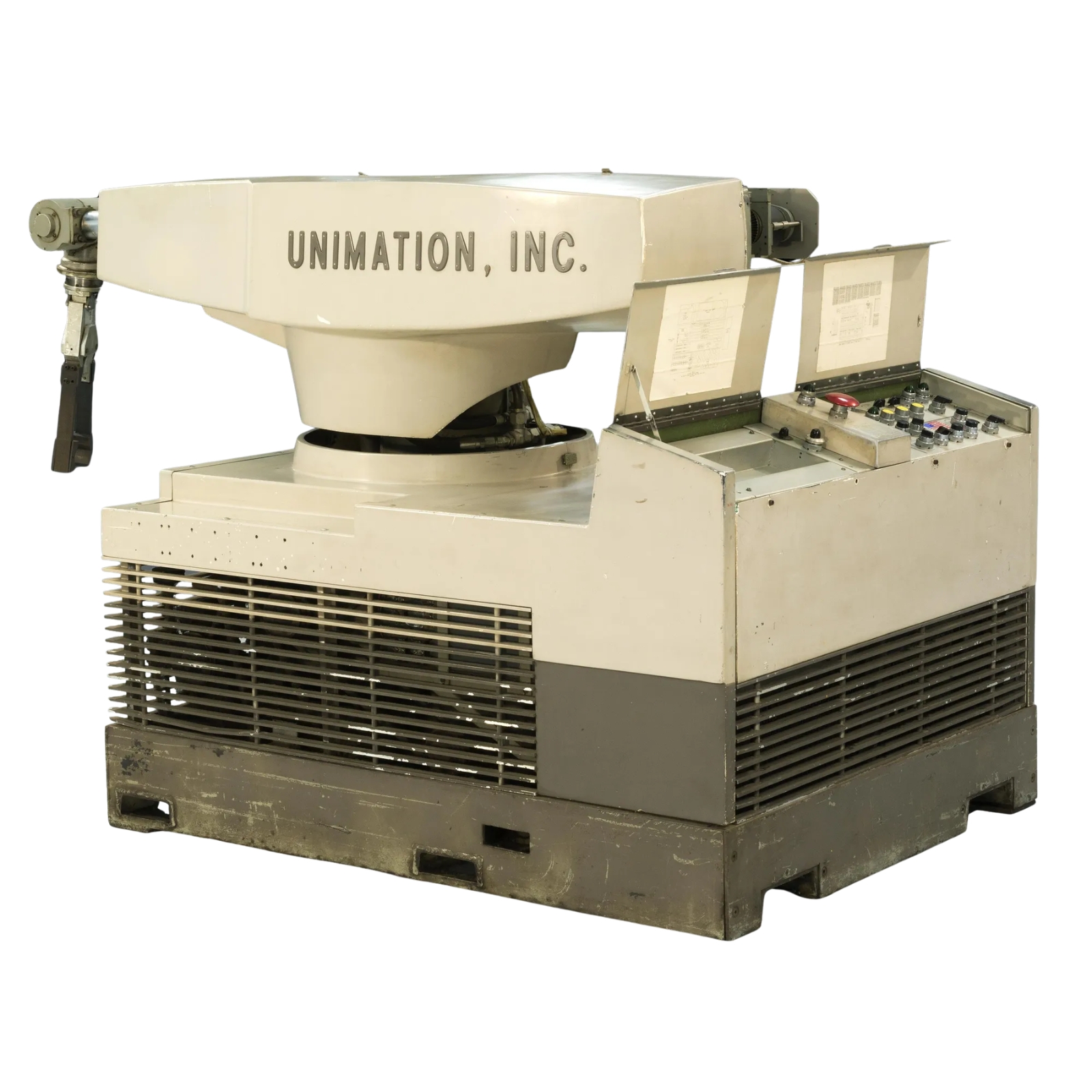
Unimation · Industrial · 1961
The Unimate is the world's first industrial robot — conceived by George Devol (who patented 'Programmed Article Transfer' in 1954) and commercialised by Joseph Engelberger through Unimation, with the first unit installed on a General Motors die-casting line in Ewing Township, New Jersey, in 1961. A roughly 1,800 kg hydraulic arm with polar-coordinate motion (~5 axes) and a magnetic-drum memory that stored taught positions, it could lift heavy die-cast parts (payloads into the hundreds of kilograms) and perform spot welding on automobile bodies — dangerous, repetitive jobs it took over from human workers. The Unimate launched the entire industrial-robotics industry, made GM assembly lines the proving ground for automation, and led directly to Unimation's later PUMA. NOTE: The Unimate predates modern spec documentation; figures here reflect the historical record (payload ~227 kg / ~500 lb class, hydraulic drive, magnetic-drum control) and are intentionally limited to verified historical facts rather than a reconstructed datasheet.
Price level: ★☆☆☆☆
View full interactive profile, comparisons & videos →| Category | Industrial |
| Sub-type | Historic Industrial Robot (world's first) |
| Status | Discontinued |
| Year | 1961 |
| Origin | USA |
| Announced | 1961 |
| Released | 1961 |
| Weight | 1800 kg |
| Frame | Steel base + aluminium arm |
| Degrees of freedom | 5 |
| Payload | 227 kg |
| Repeatability | ±1.25 mm |
| Actuator type | Hydraulic actuators; magnetic-drum program memory |
| Use cases | Die-casting extraction, Spot welding (GM assembly lines), Material handling, Machine tending |
| Made in | USA (Danbury, Connecticut) |