
NEC · Social · 2001
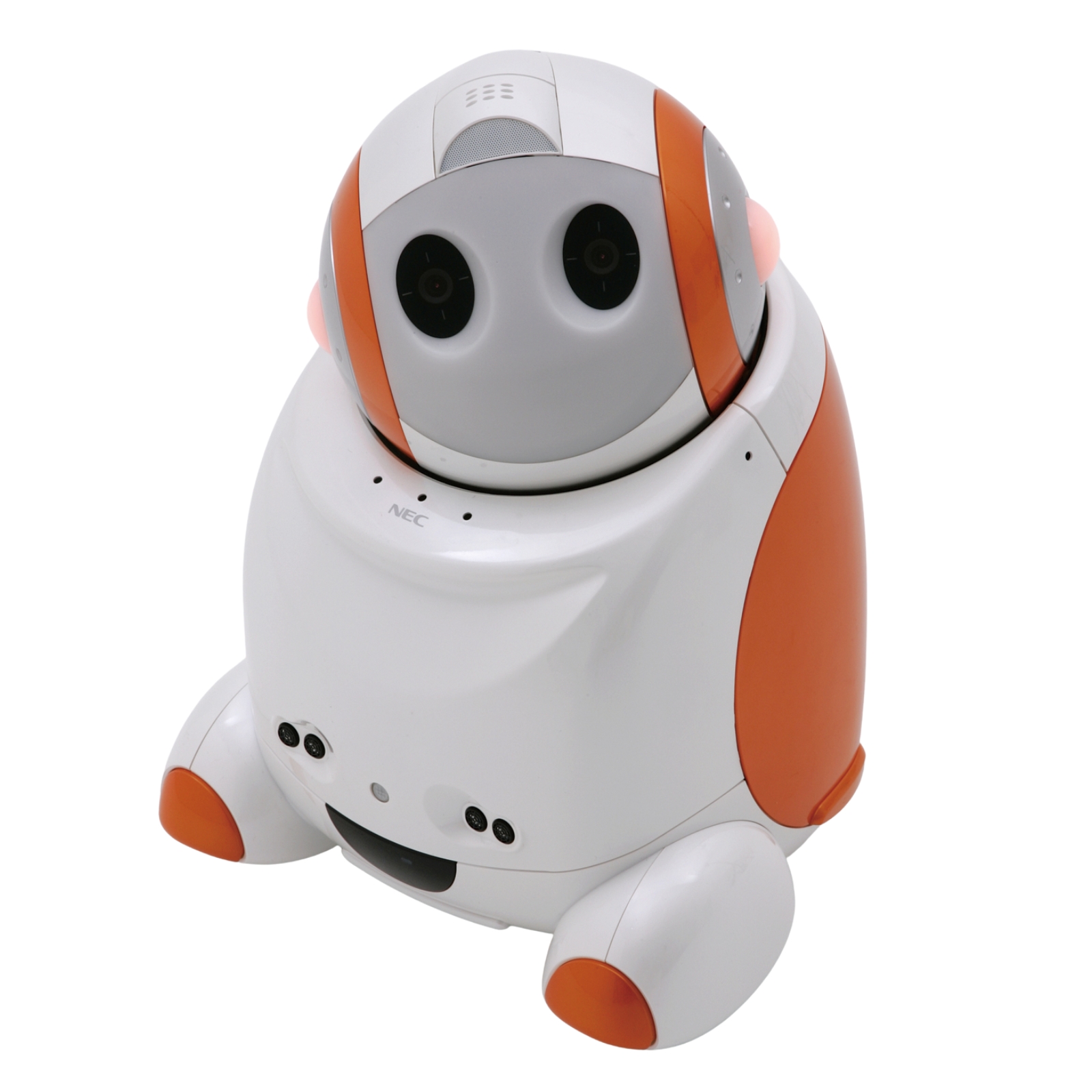
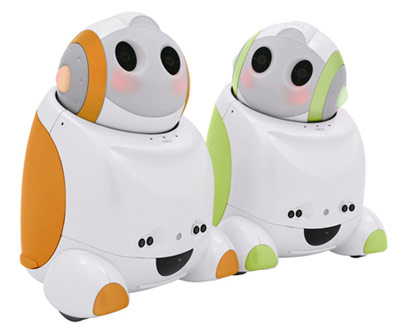
NEC's 'Partner-type Personal Robot' — a cute, toddler-sized companion robot developed from 1997 (as the R100 prototype) and named PaPeRo in 2001, one of the earliest robots built purely around the human-machine interface rather than locomotion or labour. Standing 385 mm and weighing 5 kg on a three-wheel base, it roams the home looking for faces using twin CCD-camera 'eyes' with facial recognition (identifying ~10 people), then starts a conversation. Four microphones let it locate and understand speech (recognising ~650 commands and speaking ~3,000 phrases), nine capacitance touch sensors sense patting and stroking, and ultrasonic, floor, lift and bumper sensors handle navigation. An expressive LED face (in eyes, mouth, cheeks and ears), stereo speakers, a wireless modem and TV/cellphone links round it out. Never sold publicly, PaPeRo ran for years in NEC's eldercare and smart-home experiments and spawned Childcare, PaPeRo 2005, Mini and Petit variants.
Price on application
View full interactive profile, comparisons & videos → Check price on Amazon →| Category | Social |
| Sub-type | Partner Personal Robot |
| Status | Discontinued |
| Year | 2001 |
| Origin | Japan |
| Dimensions (H×W×D) | 385 × 248 × 245 mm |
| Weight | 5 kg |
| Max speed | 0.2 m/s |
| Battery life | 150 min |
| Charge time | 150 min |
| Camera | 2x CCD (330k-pixel) — face recognition |
| Connectivity | Wi-Fi |
| Use cases | Companionship, Elderly care, Childcare / monitoring, Message / email reading, Home entertainment |
| Made in | Japan |
